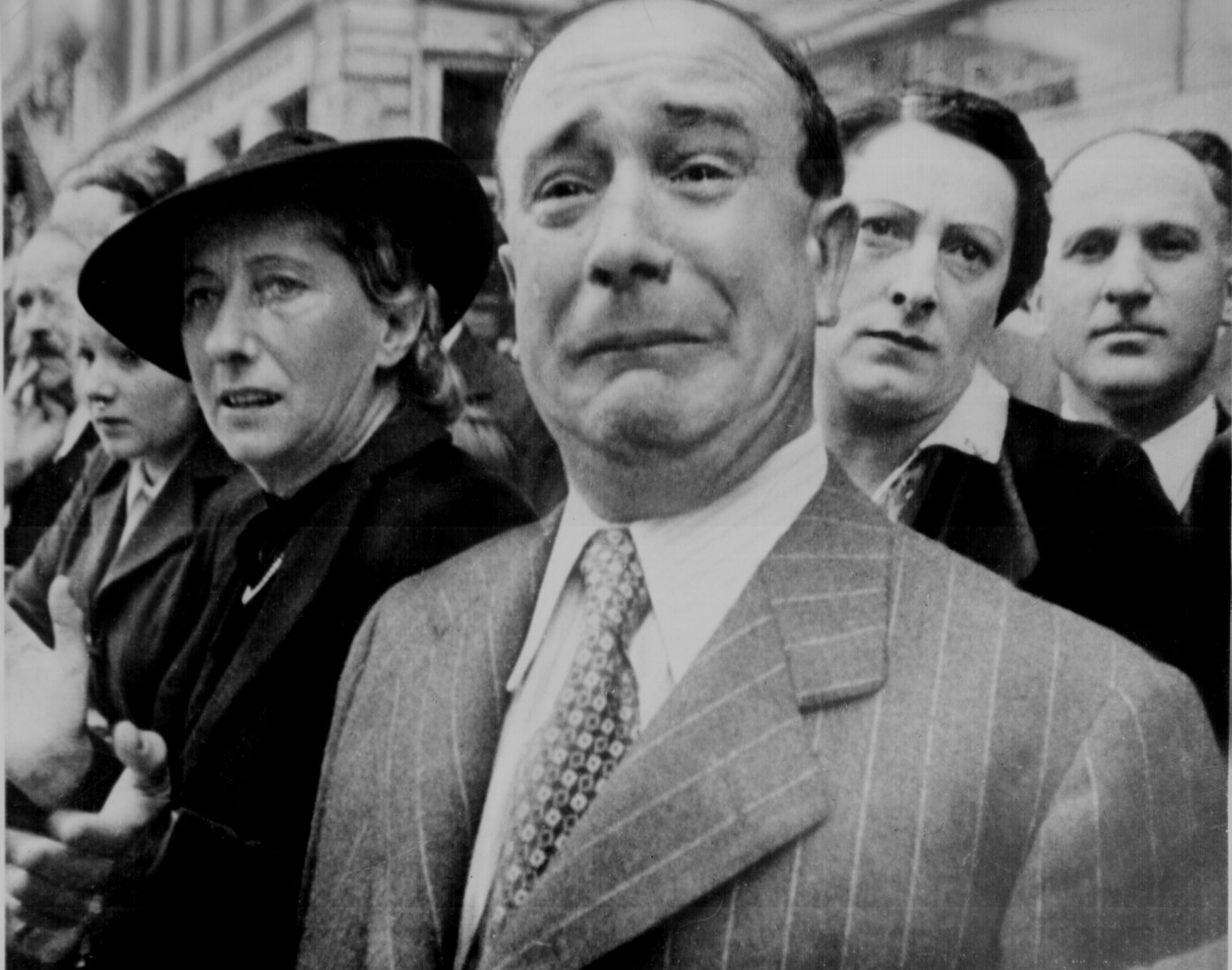
File:Weeping Parisian from NARA Ww2-81.jpg
From WikiMD's WELLNESSPEDIA

Size of this preview: 743 × 600 pixels. Other resolutions: 297 × 240 pixels | 595 × 480 pixels | 951 × 768 pixels | 1,269 × 1,024 pixels | 2,537 × 2,048 pixels | 2,947 × 2,379 pixels.
Original file (2,947 × 2,379 pixels, file size: 2.92 MB, MIME type: image/jpeg)
Summary
| Description |
English: "A Frenchman sheds tears of patriotic grief as flags of his country's lost regiments are exiled to Africa", according to the caption in the 3 March 1941 issue of Life magazine. Incorrectly captioned by NARA as "A Frenchman weeps as German soldiers march into the French capital, Paris, on June 14, 1940, after the Allied armies had been driven back across France." 208-PP-10A-3.
User comments:
|
|||
| Date | ||||
| Source |
National Archives and Records Administration, https://www.archives.gov/research/military/ww2/photos/images/ww2-81.jpg. Local Identifier 208-PP-93(3)
|
|||
| Author | Office for Emergency Management. Office of War Information. Overseas Operations Branch. New York Office. News and Features Bureau. (12/17/1942 - 09/15/1945) | |||
| Other versions |
.jpg) |


Licensing

|
This image (or other media file) is in the public domain because its copyright has expired and its author is anonymous.
This applies to the European Union and those countries with a copyright term of 70 years after the work was made available to the public and the author never disclosed their identity. Important: Always mention where the image comes from, as far as possible, and make sure the author never claimed authorship.  Note: In Germany and possibly other countries, certain anonymous works published before July 1, 1995 are copyrighted until 70 years after the death of the author. See Übergangsrecht. Please use this template only if the author never claimed authorship or their authorship never became public in any other way. If the work is anonymous or pseudonymous (e.g., published only under a corporate or organization's name), use this template for images published more than 70 years ago.
For a work made available to the public in the United Kingdom, please use Template:PD-UK-unknown instead.
|

|
File history
Click on a date/time to view the file as it appeared at that time.
| Date/Time | Thumbnail | Dimensions | User | Comment | |
|---|---|---|---|---|---|
| current | 17:33, 21 October 2009 | | 2,947 × 2,379 (2.92 MB) | wikimediacommons>Pieter Kuiper | higher resolution from http://narademo.umiacs.umd.edu/cgi-bin/isadg/viewobject.pl?object=73180 |
File usage
The following page uses this file: