Accessory meningeal artery

The accessory meningeal artery is a small artery that supplies the dura mater of the brain. It is a branch of the maxillary artery, which is itself a major branch of the external carotid artery.
Anatomy[edit]
The accessory meningeal artery typically arises from the first part of the maxillary artery, although it can sometimes originate directly from the middle meningeal artery. It enters the cranial cavity through the foramen ovale, a passage in the sphenoid bone.
Once inside the cranial cavity, the accessory meningeal artery supplies the dura mater, the outermost of the three layers of the meninges that cover the brain and spinal cord. It may also supply small branches to the trigeminal ganglion and the cavernous sinus.
Variations[edit]
The presence and size of the accessory meningeal artery can vary significantly among individuals. In some cases, it may be absent, while in others, it may be quite prominent. Its course and connections with other arteries can also vary.
Clinical significance[edit]
The accessory meningeal artery is of clinical importance in certain surgical procedures involving the base of the skull. It may be encountered during surgeries for trigeminal neuralgia or other conditions affecting the trigeminal nerve.
In some cases, the accessory meningeal artery can be involved in epidural hematomas, which are collections of blood between the dura mater and the skull. Understanding its anatomy is crucial for neurosurgeons and radiologists.
Related pages[edit]
Accessory_meningeal_artery[edit]
-
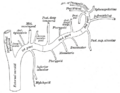 Accessory meningeal artery
 -
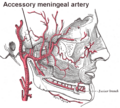 Accessory meningeal artery


Medical Disclaimer: WikiMD is for informational purposes only and is not a substitute for professional medical advice. Content may be inaccurate or outdated and should not be used for diagnosis or treatment. Always consult your healthcare provider for medical decisions. Verify information with trusted sources such as CDC.gov and NIH.gov. By using this site, you agree that WikiMD is not liable for any outcomes related to its content. See full disclaimer.
Credits:Most images are courtesy of Wikimedia commons, and templates, categories Wikipedia, licensed under CC BY SA or similar.
Translate page: - East Asian
中文,
日本,
한국어,
South Asian
हिन्दी,
தமிழ்,
తెలుగు,
Urdu,
ಕನ್ನಡ,
Southeast Asian
Indonesian,
Vietnamese,
Thai,
မြန်မာဘာသာ,
বাংলা
European
español,
Deutsch,
français,
Greek,
português do Brasil,
polski,
română,
русский,
Nederlands,
norsk,
svenska,
suomi,
Italian
Middle Eastern & African
عربى,
Turkish,
Persian,
Hebrew,
Afrikaans,
isiZulu,
Kiswahili,
Other
Bulgarian,
Hungarian,
Czech,
Swedish,
മലയാളം,
मराठी,
ਪੰਜਾਬੀ,
ગુજરાતી,
Portuguese,
Ukrainian

