File:Fatty acid carbon numbering.svg
Original file (SVG file, nominally 1,276 × 270 pixels, file size: 4 KB)
Summary[edit]
| Summary | |
|---|---|
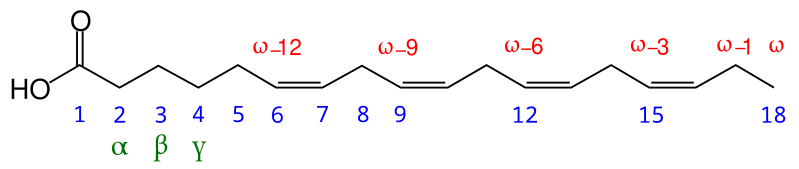
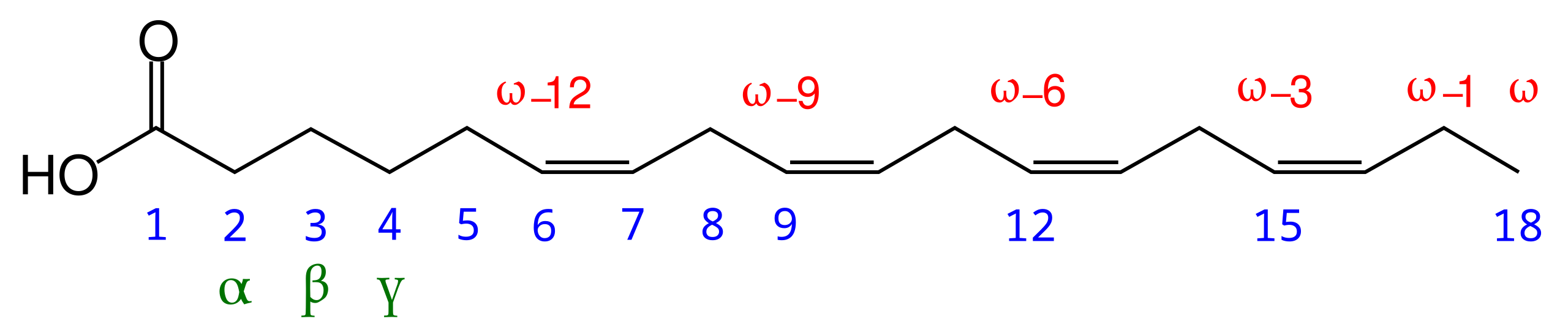
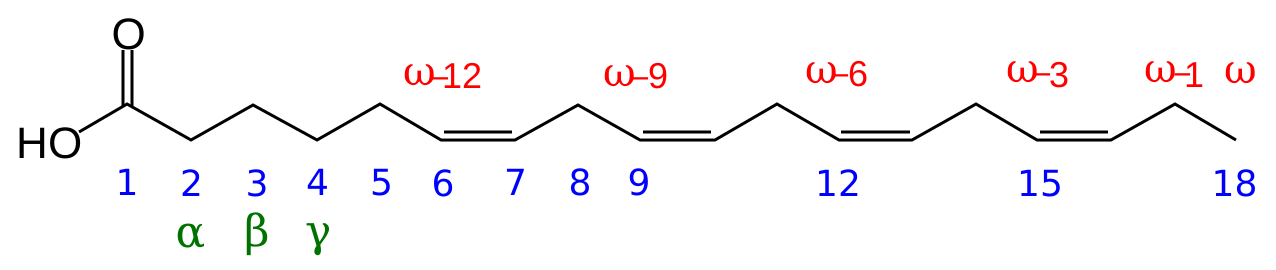
| Description | Carbon numbering schemas for fatty acids:
Systematic IUPAC numbering (
       C
       −
       1
       ,
       C
       −
       2
       ,
       C
       −
       3
       ,
       .
       .
       .


   {\displaystyle C-1,C-2,C-3,...}
) starting from 1 at the carboxyl carbon (blue). Old Greek letter labels (
       α
       ,
       β
       ,
       γ
       ,
       δ
       ,
       .
       .
       .


   {\displaystyle \alpha ,\beta ,\gamma ,\delta ,...}
) starting at the carbon after the carboxyl (green). Omega-minus numbering (
       ω
       ,
       ω
       −
       1
       ,
       ω
       −
       2
       ,
       .
       .
       .


   {\displaystyle \omega ,\omega -1,\omega -2,...}
) starting at the end opposite to the carboxyl (red). The position of a double bond is always the carbon closest to the carboxyl, even in the omega numbering. Thus a
       ω
       −
       3


   {\displaystyle \omega -3}

acid with 18 carbons (as shown) has the bond between carbons


       18
       −
       3
       =
       15


   {\displaystyle 18-3=15}

and


       18
       −
       2
       =
       16


   {\displaystyle 18-2=16}
. A common mistake is to say that the last carbon is
       ω
       −
       1


   {\displaystyle \omega -1}
. Another common mistake is to say that the position of a bond in omega-notation is the number of the carbon closest to the end. For double bonds, these two mistakes happen to compensate each other. However, for substitutions and other purposes, they don't: a hydroxyl at
       ω
       −
       3


   {\displaystyle \omega -3}

is at carbon 15, not 16.[1]
Note also that the "−" in the omega-notation is a minus sign, and
       ω
       −
       3


   {\displaystyle \omega -3}
should in principle be read "omega minus three". However, it is very common (especially in non-scientific literature) to write it "ω-3" (with a hyphen/dash) and read it as "omega-three". |
| Source | Wikimedia Commons |
| Author | Vectorization: Alhadis |
| Permission | See Commons |
Licensing[edit]
Creative Commons Attribution-ShareAlike 4.0 International (CC BY-SA 4.0)
This file is licensed under the Creative Commons Attribution-ShareAlike 4.0 International license.
You are free to:
- Share — copy and redistribute the material.
- Adapt — remix, transform, and build upon the material.
Under the following conditions:
- Attribution — appropriate credit must be given.
- ShareAlike — derivative works must be distributed under the same license.
Official license: CC BY-SA 4.0
Original attribution and file history: Wikimedia Commons
File history
Click on a date/time to view the file as it appeared at that time.
| Date/Time | Thumbnail | Dimensions | User | Comment | |
|---|---|---|---|---|---|
| current | 01:20, 2 June 2026 | | 1,276 × 270 (4 KB) | Maintenance script (talk | contribs) | == Summary == Importing file |
You cannot overwrite this file.
File usage
The following 2 pages use this file: