Acoustic tweezers
Acoustic tweezers are a type of biomedical technology that use sound waves to manipulate cells, particles, and other microscopic entities. This technology has a wide range of applications in biomedical research, diagnostics, and therapeutics.
Overview[edit]
Acoustic tweezers operate on the principle of acoustic radiation force, which is the force exerted by a sound wave on an object in its path. This force can be used to trap and manipulate small particles in a controlled manner. The technology was first developed in the late 20th century and has since been refined and expanded upon.
Applications[edit]
Acoustic tweezers have a variety of applications in the field of biomedicine. They can be used to sort cells, manipulate DNA and proteins, and even to perform surgery on a microscopic scale. They are also used in drug delivery systems, where they can be used to guide drugs to specific locations in the body.
Advantages[edit]
One of the main advantages of acoustic tweezers is their non-invasiveness. Unlike other methods of cell manipulation, such as optical tweezers, acoustic tweezers do not require the cells to be labeled or modified in any way. This makes them ideal for use in sensitive applications, such as stem cell research and cancer research.
Limitations[edit]
Despite their many advantages, acoustic tweezers also have some limitations. For example, they can only manipulate particles that are larger than the wavelength of the sound wave being used. This means that they are not suitable for manipulating very small particles, such as viruses or molecules.
Future Directions[edit]
Research is currently underway to overcome the limitations of acoustic tweezers and to expand their range of applications. For example, researchers are exploring ways to use acoustic tweezers to manipulate particles at the nanoscale, which could open up new possibilities in the field of nanomedicine.
-
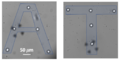 Cells patterned with selective acoustical tweezers
 -
Figure 1 from Zhangming's study
-
Figure 4 from Zhangming's study


Medical Disclaimer: WikiMD is for informational purposes only and is not a substitute for professional medical advice. Content may be inaccurate or outdated and should not be used for diagnosis or treatment. Always consult your healthcare provider for medical decisions. Verify information with trusted sources such as CDC.gov and NIH.gov. By using this site, you agree that WikiMD is not liable for any outcomes related to its content. See full disclaimer.
Credits:Most images are courtesy of Wikimedia commons, and templates, categories Wikipedia, licensed under CC BY SA or similar.
Translate page: - East Asian
中文,
日本,
한국어,
South Asian
हिन्दी,
தமிழ்,
తెలుగు,
Urdu,
ಕನ್ನಡ,
Southeast Asian
Indonesian,
Vietnamese,
Thai,
မြန်မာဘာသာ,
বাংলা
European
español,
Deutsch,
français,
Greek,
português do Brasil,
polski,
română,
русский,
Nederlands,
norsk,
svenska,
suomi,
Italian
Middle Eastern & African
عربى,
Turkish,
Persian,
Hebrew,
Afrikaans,
isiZulu,
Kiswahili,
Other
Bulgarian,
Hungarian,
Czech,
Swedish,
മലയാളം,
मराठी,
ਪੰਜਾਬੀ,
ગુજરાતી,
Portuguese,
Ukrainian


