Crab louse
Crab louse (also known as Pthirus pubis) is a tiny insect that infests the hair and skin. The crab louse is a type of parasite that survives by feeding on human blood. The most common symptom of a crab louse infection is intense itching in the area of the infestation.
Overview[edit]
Crab louse is a type of lice that is different from the head and body lice. It is named 'crab louse' because it resembles a miniature crab. The crab louse is also known as the pubic louse and is most commonly spread through sexual contact. Non-sexual routes of transmission include through sharing of bedding, clothing, or towels.
Symptoms[edit]
The most common symptom of a crab louse infection is intense itching, which is caused by an allergic reaction to the louse bites. Other symptoms may include low-grade fever, irritability, and the presence of small blue spots or sores in the area of the infestation.
Treatment[edit]
Treatment for crab louse involves the use of over-the-counter or prescription medications that kill lice and their eggs (nits). In addition, all clothing, bedding, and towels used by the infested person must be washed in hot water or dry-cleaned.
Prevention[edit]
Prevention of crab louse infestations involves avoiding sexual contact with an infested person and not sharing bedding, clothing, or towels with an infested person.
See also[edit]

This WikiMD article can only be edited by registered and verified editors. You can log in or register.
Crab louse[edit]
-
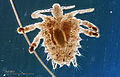 Crab louse (251 23) Female, from a human host
 -
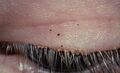 Pubic lice on eye-lashes
 -
Crab louse 01
-
Crab louse 02
-
 Crab egg
 -
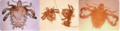 Crab Lice CDC
_Female,_from_a_human_host.jpg)


Medical Disclaimer: WikiMD is for informational purposes only and is not a substitute for professional medical advice. Content may be inaccurate or outdated and should not be used for diagnosis or treatment. Always consult your healthcare provider for medical decisions. Verify information with trusted sources such as CDC.gov and NIH.gov. By using this site, you agree that WikiMD is not liable for any outcomes related to its content. See full disclaimer.
Credits:Most images are courtesy of Wikimedia commons, and templates, categories Wikipedia, licensed under CC BY SA or similar.
Translate page: - East Asian
中文,
日本,
한국어,
South Asian
हिन्दी,
தமிழ்,
తెలుగు,
Urdu,
ಕನ್ನಡ,
Southeast Asian
Indonesian,
Vietnamese,
Thai,
မြန်မာဘာသာ,
বাংলা
European
español,
Deutsch,
français,
Greek,
português do Brasil,
polski,
română,
русский,
Nederlands,
norsk,
svenska,
suomi,
Italian
Middle Eastern & African
عربى,
Turkish,
Persian,
Hebrew,
Afrikaans,
isiZulu,
Kiswahili,
Other
Bulgarian,
Hungarian,
Czech,
Swedish,
മലയാളം,
मराठी,
ਪੰਜਾਬੀ,
ગુજરાતી,
Portuguese,
Ukrainian

