Drosophila melanogaster
Drosophila melanogaster is a species of fly (the taxonomic order Diptera) in the family Drosophilidae. The species is known generally as the common fruit fly or vinegar fly. Starting with Charles W. Woodworth's proposal of the use of this species as a model organism, D. melanogaster continues to be widely used for biological research in genetics, physiology, microbial pathogenesis, and life history evolution. It is typically used because it is an animal species that is easy to care for, breeds quickly, and lays many eggs.
Description[edit]
D. melanogaster is a small, common fly found near unripe and rotted fruit. It has been in use for over a century to study genetics and behavior. It is typically yellow-brown in color, has red eyes, and is about 3 mm in length.
Genetics[edit]
D. melanogaster is a popular experimental animal because it is easily cultured en masse out of the wild, has a short generation time, and mutant animals are readily obtainable. In 1906, Thomas Hunt Morgan began his work on D. melanogaster and reported his first finding of a white-eyed mutant in 1910 to the academic community.
Use in research[edit]
D. melanogaster is widely used for biological research in studies of genetics, physiology, microbial pathogenesis, and life history evolution. It is also frequently used in studies of mutation, a topic widely studied in genetics and evolutionary biology.
See also[edit]
References[edit]

This WikiMD article can only be edited by registered and verified editors. You can log in or register.
-
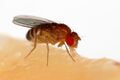 Drosophila melanogaster Proboscis
 -
Biology Illustration Animals Insects Drosophila melanogaster
-
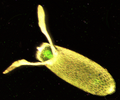 Drosophila egg
 -
Arrhythmia Caused by a Drosophila Tropomyosin Mutation Is Revealed Using a Novel Optical Coherence
-
Fruit flies mating
-
Turning Males On Activation of Male Courtship Behavior in Drosophila melanogaster
-
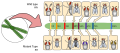 Drosophila Gene Linkage Map
 -
Fruit Fly Eye Colors
-
Drosophila melanogaster Cy allele curly wings
-
Black Body Mutation Drosophila melanogaster male
-
Wild-Type vs. Miniature Wings
-
Drosophila chromosome diagram


Medical Disclaimer: WikiMD is for informational purposes only and is not a substitute for professional medical advice. Content may be inaccurate or outdated and should not be used for diagnosis or treatment. Always consult your healthcare provider for medical decisions. Verify information with trusted sources such as CDC.gov and NIH.gov. By using this site, you agree that WikiMD is not liable for any outcomes related to its content. See full disclaimer.
Credits:Most images are courtesy of Wikimedia commons, and templates, categories Wikipedia, licensed under CC BY SA or similar.
Translate page: - East Asian
中文,
日本,
한국어,
South Asian
हिन्दी,
தமிழ்,
తెలుగు,
Urdu,
ಕನ್ನಡ,
Southeast Asian
Indonesian,
Vietnamese,
Thai,
မြန်မာဘာသာ,
বাংলা
European
español,
Deutsch,
français,
Greek,
português do Brasil,
polski,
română,
русский,
Nederlands,
norsk,
svenska,
suomi,
Italian
Middle Eastern & African
عربى,
Turkish,
Persian,
Hebrew,
Afrikaans,
isiZulu,
Kiswahili,
Other
Bulgarian,
Hungarian,
Czech,
Swedish,
മലയാളം,
मराठी,
ਪੰਜਾਬੀ,
ગુજરાતી,
Portuguese,
Ukrainian


