Phycobilisome
Phycobilisome is a light-harvesting complex found in cyanobacteria and red algae. It is a part of the photosynthetic system and plays a crucial role in the process of photosynthesis.
Structure[edit]
Phycobilisomes are large protein complexes that are attached to the thylakoid membrane. They are composed of phycobiliproteins, which are a group of water-soluble proteins present in cyanobacteria and red algae. These proteins are responsible for capturing light energy and transferring it to the chlorophyll molecules.
The structure of a phycobilisome is highly organized. It consists of a core and several peripheral rods. The core contains allophycocyanin, while the rods contain phycocyanin and phycoerythrin.
Function[edit]
The primary function of phycobilisomes is to absorb light energy and transfer it to the photosynthetic reaction centers. They are particularly efficient at capturing light in the blue and green regions of the spectrum, which allows cyanobacteria and red algae to perform photosynthesis in deep water where these wavelengths of light are most available.
Phycobilisomes also play a role in the regulation of light energy. When the light intensity is too high, they can dissipate excess energy to prevent damage to the photosynthetic apparatus.
Significance[edit]
Phycobilisomes are of significant interest in the field of biotechnology. Due to their ability to absorb and transfer light energy efficiently, they have potential applications in solar energy conversion and optoelectronic devices.
In addition, phycobiliproteins are used as fluorescent markers in immunology, cell biology, and microscopy due to their high fluorescence quantum yield and stability.
| Photosynthesis | ||||||||||
|---|---|---|---|---|---|---|---|---|---|---|
This photosynthesis-related article is a stub.
|
 | This protein-related article is a stub. You can help WikiMD by expanding the page. |
-
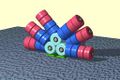 Structure of a phycobilisome
 -
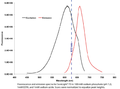 Excitation and emission of phycobilisome
 -
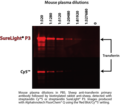 Phycobilisome Western blot


Medical Disclaimer: WikiMD is for informational purposes only and is not a substitute for professional medical advice. Content may be inaccurate or outdated and should not be used for diagnosis or treatment. Always consult your healthcare provider for medical decisions. Verify information with trusted sources such as CDC.gov and NIH.gov. By using this site, you agree that WikiMD is not liable for any outcomes related to its content. See full disclaimer.
Credits:Most images are courtesy of Wikimedia commons, and templates, categories Wikipedia, licensed under CC BY SA or similar.
Translate page: - East Asian
中文,
日本,
한국어,
South Asian
हिन्दी,
தமிழ்,
తెలుగు,
Urdu,
ಕನ್ನಡ,
Southeast Asian
Indonesian,
Vietnamese,
Thai,
မြန်မာဘာသာ,
বাংলা
European
español,
Deutsch,
français,
Greek,
português do Brasil,
polski,
română,
русский,
Nederlands,
norsk,
svenska,
suomi,
Italian
Middle Eastern & African
عربى,
Turkish,
Persian,
Hebrew,
Afrikaans,
isiZulu,
Kiswahili,
Other
Bulgarian,
Hungarian,
Czech,
Swedish,
മലയാളം,
मराठी,
ਪੰਜਾਬੀ,
ગુજરાતી,
Portuguese,
Ukrainian

