Superficial cervical lymph nodes
[[File: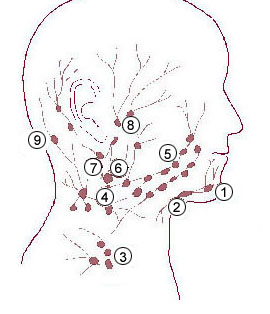 |frameless|alt=]]

| Details | |
|---|---|
| Synonyms | |
| Pronunciation | |
| Carnegie stage | |
| Days | |
| Precursor | |
| Gives rise to | |
| Part of | |
The superficial cervical lymph nodes are a group of lymph nodes located in the neck. They are part of the lymphatic system, which plays a crucial role in the body's immune response by filtering lymph fluid and trapping pathogens.
Anatomy[edit]
The superficial cervical lymph nodes are situated along the external jugular vein and lie superficial to the sternocleidomastoid muscle. They are responsible for draining lymph from the superficial tissues of the head and neck, including the scalp, face, and superficial ear regions.
Function[edit]
These lymph nodes filter lymphatic fluid, removing bacteria, viruses, and other foreign particles. They also play a role in the immune response by housing lymphocytes, which are white blood cells that help fight infection.
Clinical significance[edit]
Enlargement of the superficial cervical lymph nodes can occur due to infections, such as upper respiratory tract infections, or more serious conditions like lymphoma or metastatic cancer. Palpation of these nodes is a common part of a physical examination when assessing for signs of infection or malignancy.
Also see[edit]
| Organs of the lymphatic system | ||||
|---|---|---|---|---|
|

Medical Disclaimer: WikiMD is for informational purposes only and is not a substitute for professional medical advice. Content may be inaccurate or outdated and should not be used for diagnosis or treatment. Always consult your healthcare provider for medical decisions. Verify information with trusted sources such as CDC.gov and NIH.gov. By using this site, you agree that WikiMD is not liable for any outcomes related to its content. See full disclaimer.
Credits:Most images are courtesy of Wikimedia commons, and templates, categories Wikipedia, licensed under CC BY SA or similar.
Translate page: - East Asian
中文,
日本,
한국어,
South Asian
हिन्दी,
தமிழ்,
తెలుగు,
Urdu,
ಕನ್ನಡ,
Southeast Asian
Indonesian,
Vietnamese,
Thai,
မြန်မာဘာသာ,
বাংলা
European
español,
Deutsch,
français,
Greek,
português do Brasil,
polski,
română,
русский,
Nederlands,
norsk,
svenska,
suomi,
Italian
Middle Eastern & African
عربى,
Turkish,
Persian,
Hebrew,
Afrikaans,
isiZulu,
Kiswahili,
Other
Bulgarian,
Hungarian,
Czech,
Swedish,
മലയാളം,
मराठी,
ਪੰਜਾਬੀ,
ગુજરાતી,
Portuguese,
Ukrainian

