1854 Broad Street cholera outbreak
1854 Broad Street cholera outbreak
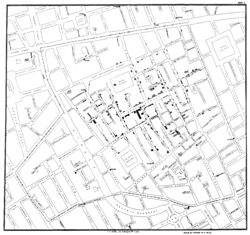

The 1854 Broad Street cholera outbreak was a severe outbreak of cholera that occurred in the Soho district of London, England, in 1854. This outbreak is historically significant because it led to a major advancement in the understanding of the transmission of infectious diseases, particularly through the work of John Snow, who is often credited as one of the founders of modern epidemiology.
Background[edit]
Cholera is an infectious disease caused by the bacterium Vibrio cholerae, which is typically spread through contaminated water. In the 19th century, cholera was a major public health threat in Europe and North America, with several pandemics occurring during this period.
In 1854, London was experiencing a cholera epidemic, and the Soho district was one of the hardest hit areas. At the time, the prevailing theory of disease transmission was the miasma theory, which suggested that diseases were spread by "bad air" or miasmas.
The Outbreak[edit]
The outbreak began in late August 1854 and rapidly spread through the Soho area. Within a week, over 500 people had died. The epicenter of the outbreak was identified as the area around Broad Street (now Broadwick Street).
John Snow's Investigation[edit]
John Snow, a physician and pioneer in the field of epidemiology, conducted a detailed investigation of the outbreak. He created a map (see image above) plotting the locations of cholera cases and found a significant cluster around the Broad Street water pump.
Snow hypothesized that the cholera was being spread through contaminated water from this pump. To test his theory, he persuaded local authorities to remove the handle of the pump on September 8, 1854. Following the removal, the number of new cholera cases in the area declined sharply.
Henry Whitehead's Role[edit]
Henry Whitehead, a local clergyman, initially doubted Snow's theory but later became a key ally. Whitehead conducted his own investigation and found evidence supporting Snow's hypothesis, including the case of a baby whose diaper had been washed into a cesspool that leaked into the Broad Street well.
Impact and Legacy[edit]
The Broad Street cholera outbreak and Snow's investigation were pivotal in changing public health policies and understanding of disease transmission. Snow's work laid the foundation for the germ theory of disease, which eventually replaced the miasma theory.
The outbreak also led to improvements in urban sanitation and the development of modern public health systems.
Also see[edit]
| Cholera | ||||||||||||||||||||||||||
|---|---|---|---|---|---|---|---|---|---|---|---|---|---|---|---|---|---|---|---|---|---|---|---|---|---|---|
|

Medical Disclaimer: WikiMD is for informational purposes only and is not a substitute for professional medical advice. Content may be inaccurate or outdated and should not be used for diagnosis or treatment. Always consult your healthcare provider for medical decisions. Verify information with trusted sources such as CDC.gov and NIH.gov. By using this site, you agree that WikiMD is not liable for any outcomes related to its content. See full disclaimer.
Credits:Most images are courtesy of Wikimedia commons, and templates, categories Wikipedia, licensed under CC BY SA or similar.
Translate page: - East Asian
中文,
日本,
한국어,
South Asian
हिन्दी,
தமிழ்,
తెలుగు,
Urdu,
ಕನ್ನಡ,
Southeast Asian
Indonesian,
Vietnamese,
Thai,
မြန်မာဘာသာ,
বাংলা
European
español,
Deutsch,
français,
Greek,
português do Brasil,
polski,
română,
русский,
Nederlands,
norsk,
svenska,
suomi,
Italian
Middle Eastern & African
عربى,
Turkish,
Persian,
Hebrew,
Afrikaans,
isiZulu,
Kiswahili,
Other
Bulgarian,
Hungarian,
Czech,
Swedish,
മലയാളം,
मराठी,
ਪੰਜਾਬੀ,
ગુજરાતી,
Portuguese,
Ukrainian


