Apoptosome
-
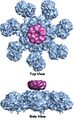 Human apoptosome CARD complex
 -
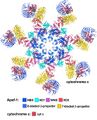 Apoptosome atomic model
 -
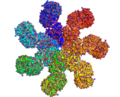 Apoptosome surface rendering
 -
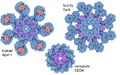 Apoptosomes


Apoptosome[edit]
The apoptosome is a large quaternary protein structure formed in the process of apoptosis, or programmed cell death. It plays a crucial role in the intrinsic pathway of apoptosis by activating caspase enzymes, which are responsible for the execution phase of cell death.
Structure[edit]
The apoptosome is typically composed of several molecules of Apaf-1, cytochrome c, and ATP or dATP. In humans, the apoptosome is a heptameric complex, meaning it consists of seven Apaf-1 molecules. Each Apaf-1 molecule contains several domains, including a caspase recruitment domain (CARD), a nucleotide-binding oligomerization domain (NOD), and a series of WD40 repeats.
Formation[edit]
The formation of the apoptosome is initiated by the release of cytochrome c from the mitochondria into the cytosol. This release is often triggered by cellular stress or damage signals. Once in the cytosol, cytochrome c binds to Apaf-1, causing a conformational change that allows Apaf-1 to bind ATP or dATP. This binding promotes the oligomerization of Apaf-1 into the heptameric apoptosome structure.
Function[edit]
The primary function of the apoptosome is to activate caspase-9, an initiator caspase. The CARD domain of Apaf-1 interacts with the CARD domain of procaspase-9, facilitating its recruitment to the apoptosome. Once bound, procaspase-9 undergoes autocatalytic cleavage to become active caspase-9. Active caspase-9 then cleaves and activates downstream effector caspases, such as caspase-3 and caspase-7, which execute the cell death program by cleaving various cellular substrates.
Regulation[edit]
The activity of the apoptosome is tightly regulated by several factors. IAPs can bind to and inhibit active caspases, thus preventing apoptosis. Additionally, the Bcl-2 family of proteins regulates the release of cytochrome c from the mitochondria, thereby controlling apoptosome formation. Pro-apoptotic members of the Bcl-2 family, such as Bax and Bak, promote cytochrome c release, while anti-apoptotic members, such as Bcl-2 and Bcl-xL, inhibit it.
Related pages[edit]
| Apoptosis | ||||||||||
|---|---|---|---|---|---|---|---|---|---|---|
This apoptosis-related article is a stub.
|

Medical Disclaimer: WikiMD is for informational purposes only and is not a substitute for professional medical advice. Content may be inaccurate or outdated and should not be used for diagnosis or treatment. Always consult your healthcare provider for medical decisions. Verify information with trusted sources such as CDC.gov and NIH.gov. By using this site, you agree that WikiMD is not liable for any outcomes related to its content. See full disclaimer.
Credits:Most images are courtesy of Wikimedia commons, and templates, categories Wikipedia, licensed under CC BY SA or similar.
Translate page: - East Asian
中文,
日本,
한국어,
South Asian
हिन्दी,
தமிழ்,
తెలుగు,
Urdu,
ಕನ್ನಡ,
Southeast Asian
Indonesian,
Vietnamese,
Thai,
မြန်မာဘာသာ,
বাংলা
European
español,
Deutsch,
français,
Greek,
português do Brasil,
polski,
română,
русский,
Nederlands,
norsk,
svenska,
suomi,
Italian
Middle Eastern & African
عربى,
Turkish,
Persian,
Hebrew,
Afrikaans,
isiZulu,
Kiswahili,
Other
Bulgarian,
Hungarian,
Czech,
Swedish,
മലയാളം,
मराठी,
ਪੰਜਾਬੀ,
ગુજરાતી,
Portuguese,
Ukrainian

