Basophil cell
Basophil cell is a type of white blood cell that plays a crucial role in the immune system. Basophils are the least common of the granulocytes, constituting about 0.01% to 0.3% of circulating white blood cells. Despite their rarity, they are important players in immune response, particularly in response to parasitic infections and in allergic reactions.
Function[edit]
Basophils contain large cytoplasmic granules which store and release histamine and heparin. Histamine is a chemical that contributes to inflammatory response, while heparin is an anticoagulant. When an allergen enters the body, it triggers the basophils to release these chemicals, leading to inflammation and other symptoms of an allergic reaction.
Development[edit]
Basophils are produced in the bone marrow from stem cells. They mature in the bone marrow before being released into the bloodstream. The lifespan of a basophil in the circulation is typically 1-2 days.
Role in Disease[edit]
Basophils play a role in several diseases. In allergic reactions, they are responsible for the release of histamine and other chemicals that cause symptoms. They are also involved in autoimmune diseases, where they can contribute to inflammation and tissue damage. In addition, elevated basophil counts can be a sign of certain types of leukemia or other blood disorders.
See Also[edit]
 | This medical article is a stub. You can help WikiMD by expanding the page. |
Basophil cell gallery[edit]
-
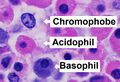 Histology of pars distalis of the anterior pituitary with chromophobes, basophils, and acidophils, annotated


Medical Disclaimer: WikiMD is for informational purposes only and is not a substitute for professional medical advice. Content may be inaccurate or outdated and should not be used for diagnosis or treatment. Always consult your healthcare provider for medical decisions. Verify information with trusted sources such as CDC.gov and NIH.gov. By using this site, you agree that WikiMD is not liable for any outcomes related to its content. See full disclaimer.
Credits:Most images are courtesy of Wikimedia commons, and templates, categories Wikipedia, licensed under CC BY SA or similar.
Translate page: - East Asian
中文,
日本,
한국어,
South Asian
हिन्दी,
தமிழ்,
తెలుగు,
Urdu,
ಕನ್ನಡ,
Southeast Asian
Indonesian,
Vietnamese,
Thai,
မြန်မာဘာသာ,
বাংলা
European
español,
Deutsch,
français,
Greek,
português do Brasil,
polski,
română,
русский,
Nederlands,
norsk,
svenska,
suomi,
Italian
Middle Eastern & African
عربى,
Turkish,
Persian,
Hebrew,
Afrikaans,
isiZulu,
Kiswahili,
Other
Bulgarian,
Hungarian,
Czech,
Swedish,
മലയാളം,
मराठी,
ਪੰਜਾਬੀ,
ગુજરાતી,
Portuguese,
Ukrainian

