Beta vulgaris
Beta Vulgaris is a plant species in the Amaranthaceae family, commonly known as beetroot, sugar beet, beet, or table beet. It is one of several cultivated varieties of Beta vulgaris grown for their edible taproots and leaves.
Description[edit]
Beta Vulgaris is a herbaceous biennial or, rarely, perennial plant with leafy stems growing to 1–2 m tall. The leaves are heart-shaped, 5–20 cm long on wild plants. The flowers are produced in dense spikes, each flower small, greenish, with five petals.
Cultivation[edit]
Cultivation of Beta Vulgaris requires a fertile soil, as the plant is subject to a disease known as 'beet scab', which causes rough patches on the root. The plant prefers cool temperatures, and the seeds are sown at a depth of 1 to 2 cm.
Uses[edit]
Beta Vulgaris is used for both culinary and medicinal purposes. The root of the beet is eaten either boiled, roasted or raw, either alone or combined with any salad vegetable. The young leaves can be added to salads, whilst the adult leaves are most commonly served boiled or steamed.
Varieties[edit]
There are several varieties of Beta Vulgaris, including the Sugar Beet, used for producing table sugar, the garden beet, which is used as a vegetable, the leaf beet, also known as Swiss Chard, and the fodder beet, used as animal feed.
Health Benefits[edit]
Beta Vulgaris is rich in essential nutrients like vitamin C, fiber, and essential minerals like potassium (essential for healthy nerve and muscle function) and manganese (which is good for your bones, liver, kidneys, and pancreas).
See Also[edit]
This plant related article is a stub. You can help WikiMD by expanding it.
Beta_vulgaris[edit]
-
 Koeh-167
 -
Suikerbiet bloem Beta vulgaris
-
 Beetseeds3d
 -
 Beta vulgaris subsp maritima 89-08
 -
Suikerbiet bloeiwijze Beta vulgaris
-
 Chard3
 -
 Beets Bundle
 -
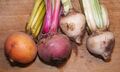 Uncommon beetroot colours
 -
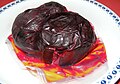 Biarava confezionata
 -
 Beta vulgaris maritima 001
 -
 Sugar beets


Medical Disclaimer: WikiMD is for informational purposes only and is not a substitute for professional medical advice. Content may be inaccurate or outdated and should not be used for diagnosis or treatment. Always consult your healthcare provider for medical decisions. Verify information with trusted sources such as CDC.gov and NIH.gov. By using this site, you agree that WikiMD is not liable for any outcomes related to its content. See full disclaimer.
Credits:Most images are courtesy of Wikimedia commons, and templates, categories Wikipedia, licensed under CC BY SA or similar.
Translate page: - East Asian
中文,
日本,
한국어,
South Asian
हिन्दी,
தமிழ்,
తెలుగు,
Urdu,
ಕನ್ನಡ,
Southeast Asian
Indonesian,
Vietnamese,
Thai,
မြန်မာဘာသာ,
বাংলা
European
español,
Deutsch,
français,
Greek,
português do Brasil,
polski,
română,
русский,
Nederlands,
norsk,
svenska,
suomi,
Italian
Middle Eastern & African
عربى,
Turkish,
Persian,
Hebrew,
Afrikaans,
isiZulu,
Kiswahili,
Other
Bulgarian,
Hungarian,
Czech,
Swedish,
മലയാളം,
मराठी,
ਪੰਜਾਬੀ,
ગુજરાતી,
Portuguese,
Ukrainian


