Crucifixion
Crucifixion is a method of capital punishment where the victim is tied or nailed to a large wooden beam and left to hang, possibly for several days, until eventual death from exhaustion and asphyxiation. It has been used in various parts of the world and is most famous for its use by the Roman Empire, which crucified the Jesus of Nazareth.
History[edit]
Crucifixion was used among the Seleucids, Carthaginians, and Romans from about the 6th century BC to the 4th century AD. In the year 337, Emperor Constantine the Great abolished it in the Roman Empire out of veneration for Jesus Christ, the most famous victim of crucifixion. It was also used as a form of punishment among the Persians, Indians, Assyrians and Scythians.
Procedure[edit]
The condemned was usually stripped naked and scourged, a process which involved a short whip with several single or braided leather thongs of variable lengths, in which small iron balls or sharp pieces of sheep bones were tied at intervals. The scourging could be severe enough to cause death.
In Christianity[edit]
In Christianity, the crucifixion of Jesus is a central event. According to the New Testament, Jesus was arrested, tried, and sentenced by Pontius Pilate to be scourged, and finally crucified by the Romans.
See also[edit]
References[edit]

This WikiMD article can only be edited by registered and verified editors. You can log in or register.
-
Crucifixion Strasbourg Unterlinden Inv88RP536
-
Gabriel Max 1866 St Julia img02
-
Justus Lipsius Crux Simplex 1629
-
De Cruce Libri Tres 47
-
Hombre de Giv'at ha-Mivtar
-
Illustrations pour Salammbô Poirson Victor-Armand
-
Alexorig
-
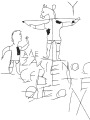 AlexGraffito
 -
Japanese Crucifixion
-
Martyrdom of Nagasaki Painting 1622
-
Your Liberty Bond will help stop this Crisco restoration and colours
-
Punishment China 1900


Medical Disclaimer: WikiMD is for informational purposes only and is not a substitute for professional medical advice. Content may be inaccurate or outdated and should not be used for diagnosis or treatment. Always consult your healthcare provider for medical decisions. Verify information with trusted sources such as CDC.gov and NIH.gov. By using this site, you agree that WikiMD is not liable for any outcomes related to its content. See full disclaimer.
Credits:Most images are courtesy of Wikimedia commons, and templates, categories Wikipedia, licensed under CC BY SA or similar.
Translate page: - East Asian
中文,
日本,
한국어,
South Asian
हिन्दी,
தமிழ்,
తెలుగు,
Urdu,
ಕನ್ನಡ,
Southeast Asian
Indonesian,
Vietnamese,
Thai,
မြန်မာဘာသာ,
বাংলা
European
español,
Deutsch,
français,
Greek,
português do Brasil,
polski,
română,
русский,
Nederlands,
norsk,
svenska,
suomi,
Italian
Middle Eastern & African
عربى,
Turkish,
Persian,
Hebrew,
Afrikaans,
isiZulu,
Kiswahili,
Other
Bulgarian,
Hungarian,
Czech,
Swedish,
മലയാളം,
मराठी,
ਪੰਜਾਬੀ,
ગુજરાતી,
Portuguese,
Ukrainian


