Dampfnudel
Dampfnudel is a traditional German dish that is often served as a dessert or a main dish. It is a type of yeast dumpling that is steamed in a pot, rather than boiled. The name "Dampfnudel" translates to "steam noodle" in English.
History[edit]
The origins of Dampfnudel can be traced back to the Middle Ages, where it was a popular dish among the poor due to its simple ingredients and easy preparation. It is believed to have originated in the southern regions of Germany, particularly in Bavaria and Palatinate.
Preparation[edit]
Dampfnudel is made from a simple dough consisting of flour, yeast, milk, sugar, and butter. The dough is left to rise before being shaped into balls and placed in a pot. A mixture of milk, sugar, and butter is then poured over the dumplings, which are covered and left to steam until they are cooked through and the liquid has evaporated, leaving a caramelized crust on the bottom.
Serving[edit]
Dampfnudel can be served either as a main dish or a dessert. When served as a main dish, it is often accompanied by savory sauces such as gravy or mushroom sauce. As a dessert, it is typically served with sweet sauces like vanilla sauce, fruit compotes, or simply dusted with powdered sugar.
Cultural Significance[edit]
Dampfnudel holds a significant place in German culinary culture. It is often associated with comfort food and is a staple in many traditional German restaurants and homes. In the Palatinate region, Dampfnudel is so beloved that it has its own dedicated day, the "Dampfnudel Day", celebrated annually.
See Also[edit]
 | This German cuisine-related article is a stub. You can help WikiMD by expanding the page. |
-
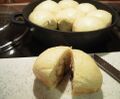 Dampfnudel
 -
Dampfnudel bakery in Regensburg
-
Dampfnudel at Christmas
-
Coat of arms of Freckenfeld


Medical Disclaimer: WikiMD is for informational purposes only and is not a substitute for professional medical advice. Content may be inaccurate or outdated and should not be used for diagnosis or treatment. Always consult your healthcare provider for medical decisions. Verify information with trusted sources such as CDC.gov and NIH.gov. By using this site, you agree that WikiMD is not liable for any outcomes related to its content. See full disclaimer.
Credits:Most images are courtesy of Wikimedia commons, and templates, categories Wikipedia, licensed under CC BY SA or similar.
Translate page: - East Asian
中文,
日本,
한국어,
South Asian
हिन्दी,
தமிழ்,
తెలుగు,
Urdu,
ಕನ್ನಡ,
Southeast Asian
Indonesian,
Vietnamese,
Thai,
မြန်မာဘာသာ,
বাংলা
European
español,
Deutsch,
français,
Greek,
português do Brasil,
polski,
română,
русский,
Nederlands,
norsk,
svenska,
suomi,
Italian
Middle Eastern & African
عربى,
Turkish,
Persian,
Hebrew,
Afrikaans,
isiZulu,
Kiswahili,
Other
Bulgarian,
Hungarian,
Czech,
Swedish,
മലയാളം,
मराठी,
ਪੰਜਾਬੀ,
ગુજરાતી,
Portuguese,
Ukrainian


