Dorsal motor nucleus of the vagus
[[File: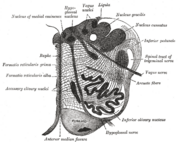 |frameless|alt=]]

| Details | |
|---|---|
| Synonyms | |
| Pronunciation | |
| Carnegie stage | |
| Days | |
| Precursor | |
| Gives rise to | |
| Part of | Medulla oblongata |
The dorsal motor nucleus of the vagus (DMV) is a cranial nerve nucleus for the vagus nerve (cranial nerve X) located in the medulla oblongata of the brainstem. It plays a crucial role in the autonomic control of the parasympathetic nervous system.
Anatomy[edit]
The dorsal motor nucleus of the vagus is situated in the floor of the fourth ventricle within the medulla oblongata. It is located dorsally to the hypoglossal nucleus and is medial to the solitary nucleus. The DMV is elongated in shape and extends from the level of the obex to the pontomedullary junction.
Function[edit]
The primary function of the dorsal motor nucleus of the vagus is to provide parasympathetic innervation to the thoracic and abdominal viscera. It is responsible for the regulation of various autonomic functions, including:
- Heart rate modulation
- Gastrointestinal motility
- Secretion of digestive enzymes
- Bronchoconstriction
The DMV sends preganglionic parasympathetic fibers through the vagus nerve to synapse on ganglia located near or within the target organs.
Neurotransmitters[edit]
The neurons of the dorsal motor nucleus of the vagus primarily use acetylcholine as their neurotransmitter. Acetylcholine acts on muscarinic receptors in the target organs to exert its effects.
Clinical Significance[edit]
Dysfunction of the dorsal motor nucleus of the vagus can lead to a variety of clinical conditions, including:
Damage to the DMV can occur due to stroke, neurodegenerative diseases, or trauma.
Connections[edit]
The dorsal motor nucleus of the vagus receives input from several sources, including:
- The solitary nucleus, which provides sensory information from the viscera
- The hypothalamus, which modulates autonomic responses
- The reticular formation, which integrates various autonomic functions
Development[edit]
The development of the dorsal motor nucleus of the vagus begins in the embryonic stage from the neural tube. It differentiates from the alar plate of the developing brainstem.
Research[edit]
Recent research has focused on the role of the dorsal motor nucleus of the vagus in vagal nerve stimulation therapies for conditions such as epilepsy and depression.
See also[edit]
| The cranial nerves | ||||||||||
|---|---|---|---|---|---|---|---|---|---|---|
|

Medical Disclaimer: WikiMD is for informational purposes only and is not a substitute for professional medical advice. Content may be inaccurate or outdated and should not be used for diagnosis or treatment. Always consult your healthcare provider for medical decisions. Verify information with trusted sources such as CDC.gov and NIH.gov. By using this site, you agree that WikiMD is not liable for any outcomes related to its content. See full disclaimer.
Credits:Most images are courtesy of Wikimedia commons, and templates, categories Wikipedia, licensed under CC BY SA or similar.
Translate page: - East Asian
中文,
日本,
한국어,
South Asian
हिन्दी,
தமிழ்,
తెలుగు,
Urdu,
ಕನ್ನಡ,
Southeast Asian
Indonesian,
Vietnamese,
Thai,
မြန်မာဘာသာ,
বাংলা
European
español,
Deutsch,
français,
Greek,
português do Brasil,
polski,
română,
русский,
Nederlands,
norsk,
svenska,
suomi,
Italian
Middle Eastern & African
عربى,
Turkish,
Persian,
Hebrew,
Afrikaans,
isiZulu,
Kiswahili,
Other
Bulgarian,
Hungarian,
Czech,
Swedish,
മലയാളം,
मराठी,
ਪੰਜਾਬੀ,
ગુજરાતી,
Portuguese,
Ukrainian

