Epithelial cell rests of Malassez
Epithelial cell rests of Malassez (ERM) are a group of residual cells that can be found in the periodontal ligament after tooth eruption. These cells are remnants of the Hertwig's epithelial root sheath (HERS) that didn't completely disappear and have the potential to proliferate and form cysts or tumors in certain conditions.
History[edit]
The ERM were first described by a French histologist, Louis-Charles Malassez, in 1885. He discovered these cell clusters while studying the periodontal ligament and named them "epithelial cell rests".
Structure[edit]
The ERM are clusters of epithelial cells that are located within the periodontal ligament. They are usually inactive, but under certain conditions, they can proliferate and form cysts or tumors. The size and number of these cell clusters can vary greatly among individuals.
Function[edit]
The primary function of the ERM is not fully understood. However, they are believed to play a role in the maintenance and repair of the periodontal ligament. Some studies suggest that they may also be involved in the formation of cementum, a hard tissue that covers the root of the tooth.
Clinical significance[edit]
The ERM are usually harmless. However, under certain conditions, they can proliferate and form cysts or tumors. This can occur as a result of inflammation, trauma, or other pathological conditions. The most common type of tumor that can arise from the ERM is the odontogenic keratocyst (OKC), which is a benign but locally aggressive tumor.
See also[edit]
References[edit]

-
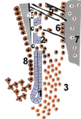 Hertwig's epithelial root sheath


Medical Disclaimer: WikiMD is for informational purposes only and is not a substitute for professional medical advice. Content may be inaccurate or outdated and should not be used for diagnosis or treatment. Always consult your healthcare provider for medical decisions. Verify information with trusted sources such as CDC.gov and NIH.gov. By using this site, you agree that WikiMD is not liable for any outcomes related to its content. See full disclaimer.
Credits:Most images are courtesy of Wikimedia commons, and templates, categories Wikipedia, licensed under CC BY SA or similar.
Translate page: - East Asian
中文,
日本,
한국어,
South Asian
हिन्दी,
தமிழ்,
తెలుగు,
Urdu,
ಕನ್ನಡ,
Southeast Asian
Indonesian,
Vietnamese,
Thai,
မြန်မာဘာသာ,
বাংলা
European
español,
Deutsch,
français,
Greek,
português do Brasil,
polski,
română,
русский,
Nederlands,
norsk,
svenska,
suomi,
Italian
Middle Eastern & African
عربى,
Turkish,
Persian,
Hebrew,
Afrikaans,
isiZulu,
Kiswahili,
Other
Bulgarian,
Hungarian,
Czech,
Swedish,
മലയാളം,
मराठी,
ਪੰਜਾਬੀ,
ગુજરાતી,
Portuguese,
Ukrainian

