Microscope slide
Microscope slide is a thin flat piece of glass, typically 75 by 26 mm (3 by 1 inches) and about 1 mm thick, used to hold objects for examination under a microscope. Typically the object is placed or secured ("mounted") on the slide, and then both are inserted together in the microscope for viewing. This arrangement allows several slide-mounted objects to be quickly inserted and removed from the microscope, interchangeably.
History[edit]
The first microscope slides were made of glass in the 19th century. The standard size of a microscope slide is about 75 by 26 mm (3 by 1 inches). The idea of a microscope slide was developed to allow for a standard way of viewing and storing small specimens under the microscope.
Types of Microscope Slides[edit]
There are several types of microscope slides, including plain slides, frosted slides, and charged slides.
- Plain slides: These are standard and commonly used microscope slides. They are typically used for routine histology and pathology.
- Frosted slides: These slides have a frosted finish on one end for easy handling, labeling, and identification.
- Charged slides: These slides are specially treated for adhesion to help cells stick to the slide.
Preparation[edit]
Microscope slides are often used with a cover slip or cover glass, a smaller and thinner sheet of glass that is placed over the specimen. The cover glass often has several functions: it holds the specimen in place (either by the weight of the cover slip or, in the case of a wet mount, by surface tension), it protects the specimen, and it adds optical properties beneficial to microscopy.
See also[edit]
References[edit]

This WikiMD article can only be edited by registered and verified editors. You can log in or register.
Microscope_slide[edit]
-
 Microscope Slides
 -
 Fedolemez
 -
 Filippo Pacini Cholera Discovery
 -
 Microscope Slides
 -
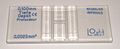 Neubauer Improved Counting Chamber
 -
 Neubauer Improved with Cells
 -
 Urinary Phase-Contrast Microscopy
 -
 Standard and Large Microscope Slide
 -
 5901 lores
 -
 Tissue Processing - Stained and Mounted Slides in the Ubiquitous 20-Slide Folder
 -
 Slide of Holotype of Lethacotyle Fijiensis Manter & Prince, 1953


Medical Disclaimer: WikiMD is for informational purposes only and is not a substitute for professional medical advice. Content may be inaccurate or outdated and should not be used for diagnosis or treatment. Always consult your healthcare provider for medical decisions. Verify information with trusted sources such as CDC.gov and NIH.gov. By using this site, you agree that WikiMD is not liable for any outcomes related to its content. See full disclaimer.
Credits:Most images are courtesy of Wikimedia commons, and templates, categories Wikipedia, licensed under CC BY SA or similar.
Translate page: - East Asian
中文,
日本,
한국어,
South Asian
हिन्दी,
தமிழ்,
తెలుగు,
Urdu,
ಕನ್ನಡ,
Southeast Asian
Indonesian,
Vietnamese,
Thai,
မြန်မာဘာသာ,
বাংলা
European
español,
Deutsch,
français,
Greek,
português do Brasil,
polski,
română,
русский,
Nederlands,
norsk,
svenska,
suomi,
Italian
Middle Eastern & African
عربى,
Turkish,
Persian,
Hebrew,
Afrikaans,
isiZulu,
Kiswahili,
Other
Bulgarian,
Hungarian,
Czech,
Swedish,
മലയാളം,
मराठी,
ਪੰਜਾਬੀ,
ગુજરાતી,
Portuguese,
Ukrainian

