Pterygoid canal
The Pterygoid Canal (also known as the Vidian Canal) is a canal in the skull that transmits the Vidian nerve, a branch of the facial nerve. It is named after the Pterygoid process, a bony protrusion in the skull, and the Greek word "oid", meaning "like", due to its location and shape.
Etymology[edit]
The term "Pterygoid" is derived from the Greek words "pteryx" and "eidos", meaning "wing" and "form" respectively. This is in reference to the wing-like shape of the Pterygoid process of the sphenoid bone, where the canal is located. The term "Vidian" is named after Guido Guidi, a 16th-century Italian anatomist who first described the canal.
Anatomy[edit]
The Pterygoid Canal runs from the foramen lacerum to the pterygopalatine fossa, passing through the sphenoid bone. It transmits the Vidian nerve, a branch of the facial nerve, and the Vidian artery, a branch of the maxillary artery.
Clinical Significance[edit]
Due to its location and the structures it transmits, the Pterygoid Canal is of clinical significance in several medical conditions. These include Vidian nerve neuralgia, a rare condition characterized by severe facial pain, and Vidian neurectomy, a surgical procedure to cut the Vidian nerve in order to treat certain conditions such as chronic rhinitis.
Related Terms[edit]
- Pterygoid process
- Vidian nerve
- Foramen lacerum
- Pterygopalatine fossa
- Sphenoid bone
- Maxillary artery
- Vidian nerve neuralgia
- Vidian neurectomy

This WikiMD article can only be edited by registered and verified editors. You can log in or register.
-
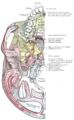 Pterygoid canal
 -
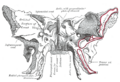 Pterygoid canal
 -
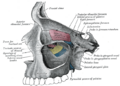 Pterygoid canal


Medical Disclaimer: WikiMD is for informational purposes only and is not a substitute for professional medical advice. Content may be inaccurate or outdated and should not be used for diagnosis or treatment. Always consult your healthcare provider for medical decisions. Verify information with trusted sources such as CDC.gov and NIH.gov. By using this site, you agree that WikiMD is not liable for any outcomes related to its content. See full disclaimer.
Credits:Most images are courtesy of Wikimedia commons, and templates, categories Wikipedia, licensed under CC BY SA or similar.
Translate page: - East Asian
中文,
日本,
한국어,
South Asian
हिन्दी,
தமிழ்,
తెలుగు,
Urdu,
ಕನ್ನಡ,
Southeast Asian
Indonesian,
Vietnamese,
Thai,
မြန်မာဘာသာ,
বাংলা
European
español,
Deutsch,
français,
Greek,
português do Brasil,
polski,
română,
русский,
Nederlands,
norsk,
svenska,
suomi,
Italian
Middle Eastern & African
عربى,
Turkish,
Persian,
Hebrew,
Afrikaans,
isiZulu,
Kiswahili,
Other
Bulgarian,
Hungarian,
Czech,
Swedish,
മലയാളം,
मराठी,
ਪੰਜਾਬੀ,
ગુજરાતી,
Portuguese,
Ukrainian

