Salicornia
Salicornia is a genus of succulent, halophyte (salt tolerant) plants that grow in salt marshes, on beaches, and among mangroves. Salicornia species are native to North America, Europe, South Africa, and South Asia.
Description[edit]
Salicornia species are small, herbaceous plants that grow from 5 to 60 cm tall. They have jointed horizontal and vertical stems that are bright green, and are covered with small, scale-like leaves. During the summer, they produce inconspicuous yellow-green flowers.
Taxonomy[edit]
The genus Salicornia was first described by Carl Linnaeus in 1753. The name Salicornia comes from the Latin words "sal" (salt) and "cornu" (horn), referring to the plant's habitat and horn-like appearance.
Ecology[edit]
Salicornia species are adapted to grow in high-salt environments, such as coastal salt marshes and mangrove swamps. They are able to tolerate salt levels that would kill most other plants.
Uses[edit]
Salicornia species are edible, and are often used in salads or as a garnish. They have a salty, slightly bitter taste. Some species, such as Salicornia europaea, are also used in the production of biofuel.
See also[edit]
References[edit]

This WikiMD article can only be edited by registered and verified editors. You can log in or register.
-
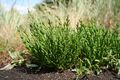 Salicornia europaea
 -
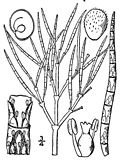 Salicornia maritima
 -
 Salicornia flowers
 -
 Salicornia rubra
 -
 Salicornia at Ballona Saltwater Marsh, California
 -
 Salicornia bigelovii
 -
 Salicornia virginica


Medical Disclaimer: WikiMD is for informational purposes only and is not a substitute for professional medical advice. Content may be inaccurate or outdated and should not be used for diagnosis or treatment. Always consult your healthcare provider for medical decisions. Verify information with trusted sources such as CDC.gov and NIH.gov. By using this site, you agree that WikiMD is not liable for any outcomes related to its content. See full disclaimer.
Credits:Most images are courtesy of Wikimedia commons, and templates, categories Wikipedia, licensed under CC BY SA or similar.
Translate page: - East Asian
中文,
日本,
한국어,
South Asian
हिन्दी,
தமிழ்,
తెలుగు,
Urdu,
ಕನ್ನಡ,
Southeast Asian
Indonesian,
Vietnamese,
Thai,
မြန်မာဘာသာ,
বাংলা
European
español,
Deutsch,
français,
Greek,
português do Brasil,
polski,
română,
русский,
Nederlands,
norsk,
svenska,
suomi,
Italian
Middle Eastern & African
عربى,
Turkish,
Persian,
Hebrew,
Afrikaans,
isiZulu,
Kiswahili,
Other
Bulgarian,
Hungarian,
Czech,
Swedish,
മലയാളം,
मराठी,
ਪੰਜਾਬੀ,
ગુજરાતી,
Portuguese,
Ukrainian

