Salmon
| Salmon | |
|---|---|
| File:Salmon.jpg
A salmon leaping in its natural habitat | |
| Salmo S. salar | |
| Scientific classification | |
| Kingdom | Animalia |
| Phylum | Chordata |
| Class | Actinopterygii |
| Order | Salmoniformes |
| Family | Salmonidae |
| Genus | Salmo |
| Species | S. salar |
| Binomial name | Salmo salar |
| Binomial authority | Linnaeus, 1758 |
| Synonyms | |
Salmon are ray-finned fish in the family Salmonidae that are native to tributaries of the North Atlantic (genus Salmo) and Pacific Ocean (genus Oncorhynchus). Many species of salmon have been introduced into non-native environments such as the Great Lakes of North America and Patagonia in South America. Salmon are significant for their nutritional value and are a popular food, celebrated for their rich content of omega-3 fatty acids and protein.
Biology[edit]
Salmon are anadromous: they are born in fresh water, migrate to the ocean, then return to fresh water to reproduce. This journey is known as spawning. After spawning, all Pacific salmon and most Atlantic salmon die, a process known as semelparity. The salmon life cycle starts with the fish laying eggs in freshwater streams. After hatching, the young salmon, called fry, spend several months to years in their natal river before migrating to the ocean. Once in the ocean, they undergo a period of rapid growth, often doubling in size.
Habitat[edit]
Salmon are found in the cold-water tributaries of the Pacific and Atlantic oceans. In the Pacific, they range from Alaska to California, and in the Atlantic, from Connecticut to Canada. Salmon require clean, cold water for successful breeding and growth. Their habitats are threatened by water pollution, overfishing, and habitat destruction due to damming and logging.
Conservation[edit]
The conservation status of salmon varies by species. Some, like the Chinook and Atlantic salmon, are considered threatened or endangered in certain regions due to overfishing, habitat loss, and pollution. Conservation efforts include habitat restoration, pollution control, and sustainable fishing practices.
Culinary Uses[edit]
Salmon is a versatile food and can be prepared in many ways, including smoking, grilling, baking, and poaching. It is a key ingredient in dishes such as gravlax, sushi, and smoked salmon. Its popularity is due in part to its health benefits, including high levels of omega-3 fatty acids, which are beneficial for heart health.
Cultural Significance[edit]
Salmon have a rich cultural significance, especially among indigenous peoples of the Pacific Northwest, where they are a symbol of life and prosperity. Salmon fishing and consumption are deeply embedded in the culture and traditions of these communities.

-
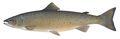 Salmo salar
 -
Salmo salar
-
 Salmon
 -
Ocean phase Chinook
-
Male freshwater phase Chinook
-
Salmon
-
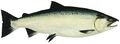 Ocean phase Coho
 -
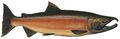 Male freshwater phase Coho
 -
Oncorhynchus masou
-
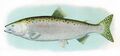 Humpback Salmon Adult Male
 -
Humpback Salmon Breeding Male
-
Ocean phase Sockeye


Medical Disclaimer: WikiMD is for informational purposes only and is not a substitute for professional medical advice. Content may be inaccurate or outdated and should not be used for diagnosis or treatment. Always consult your healthcare provider for medical decisions. Verify information with trusted sources such as CDC.gov and NIH.gov. By using this site, you agree that WikiMD is not liable for any outcomes related to its content. See full disclaimer.
Credits:Most images are courtesy of Wikimedia commons, and templates, categories Wikipedia, licensed under CC BY SA or similar.
Translate page: - East Asian
中文,
日本,
한국어,
South Asian
हिन्दी,
தமிழ்,
తెలుగు,
Urdu,
ಕನ್ನಡ,
Southeast Asian
Indonesian,
Vietnamese,
Thai,
မြန်မာဘာသာ,
বাংলা
European
español,
Deutsch,
français,
Greek,
português do Brasil,
polski,
română,
русский,
Nederlands,
norsk,
svenska,
suomi,
Italian
Middle Eastern & African
عربى,
Turkish,
Persian,
Hebrew,
Afrikaans,
isiZulu,
Kiswahili,
Other
Bulgarian,
Hungarian,
Czech,
Swedish,
മലയാളം,
मराठी,
ਪੰਜਾਬੀ,
ગુજરાતી,
Portuguese,
Ukrainian


