Bird egg
A bird egg is the organic vessel in which an embryo first begins to develop. Birds are among the most prolific egg-laying creatures, but interestingly, their eggs come in a variety of sizes, shapes, and colors. The primary function of a bird egg is to protect and nourish the developing bird embryo.
Structure and Composition[edit]
A bird egg is composed of several layers. The outermost layer is the eggshell, which is primarily made of calcium carbonate. The eggshell is porous, allowing for the exchange of gases. Inside the eggshell is the egg white or albumen, which provides water and protein to the developing embryo. The yolk is the nutrient-rich part of the egg where the embryo develops.
Egg Shape and Size[edit]
Bird eggs can be spherical, oval, or pointed. The shape of the egg is determined by the species of bird. For example, owl eggs are almost spherical, while hummingbird eggs are more oval. The size of the egg also varies greatly among bird species. The smallest bird eggs are those of the bee hummingbird, while the largest are laid by the ostrich.
Egg Color and Pattern[edit]
Bird eggs come in a variety of colors and patterns. These can range from plain white or pale blue to speckled, spotted, or streaked with brown, gray, or black. The color and pattern of the egg are influenced by the bird's environment and can serve as camouflage.
Incubation[edit]
Incubation is the process by which bird eggs are kept warm so that the embryo can develop into a hatchling. This is usually done by the parent birds sitting on the eggs. The length of the incubation period varies among species.
Cultural Significance[edit]
Bird eggs have been symbols in many cultures around the world. They are often associated with life, birth, and renewal. In some cultures, bird eggs are used in culinary dishes, while in others, they are used in traditional medicine.
See Also[edit]
 | This bird-related article is a stub. You can help WikiMD by expanding the page. |

Bird egg gallery[edit]
-
 Chicken egg diagram
 -
 Eggs, trinity zoo museum
 -
 Uria aalge MHNT Box Rouzic
 -
 Vanellus spinosus MHNT
 -
 Senegal egg
 -
 Uria aalge MHNT Rouzic
 -
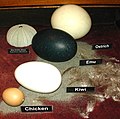 Comparison of eggs by Zureks
 -
 Oystercatcher Eggs Norway


Medical Disclaimer: WikiMD is for informational purposes only and is not a substitute for professional medical advice. Content may be inaccurate or outdated and should not be used for diagnosis or treatment. Always consult your healthcare provider for medical decisions. Verify information with trusted sources such as CDC.gov and NIH.gov. By using this site, you agree that WikiMD is not liable for any outcomes related to its content. See full disclaimer.
Credits:Most images are courtesy of Wikimedia commons, and templates, categories Wikipedia, licensed under CC BY SA or similar.
Translate page: - East Asian
中文,
日本,
한국어,
South Asian
हिन्दी,
தமிழ்,
తెలుగు,
Urdu,
ಕನ್ನಡ,
Southeast Asian
Indonesian,
Vietnamese,
Thai,
မြန်မာဘာသာ,
বাংলা
European
español,
Deutsch,
français,
Greek,
português do Brasil,
polski,
română,
русский,
Nederlands,
norsk,
svenska,
suomi,
Italian
Middle Eastern & African
عربى,
Turkish,
Persian,
Hebrew,
Afrikaans,
isiZulu,
Kiswahili,
Other
Bulgarian,
Hungarian,
Czech,
Swedish,
മലയാളം,
मराठी,
ਪੰਜਾਬੀ,
ગુજરાતી,
Portuguese,
Ukrainian

