Bromoacetic acid
Bromoacetic acid is a carboxylic acid that is acetic acid in which one of the methyl hydrogens is replaced by a bromine atom. It is a bromo monocarboxylic acid and a member of monohalogenated acetic acids. It is a conjugate acid of a bromoacetate.
Chemical Properties[edit]
Bromoacetic acid has a molecular formula of C2H3BrO2. It is a colorless or white crystalline solid with a strong, unpleasant odor. It is soluble in water and its solutions are acidic. It is a strong alkylating agent and is highly reactive.
Synthesis[edit]
Bromoacetic acid can be synthesized by the halogenation of acetic acid in the presence of red phosphorus and iodine, or by the reaction of bromine with monochloroacetic acid.
Uses[edit]
Bromoacetic acid is used as an alkylating agent in organic synthesis. It is also used in the manufacture of pharmaceuticals, dyes, and other chemicals. It is a precursor to other compounds including 2,2-dibromoacetic acid and 2-bromoacetic acid.
Safety[edit]
Bromoacetic acid is corrosive and can cause burns to the skin and eyes. It is also toxic if swallowed or inhaled. It is classified as a hazardous substance and should be handled with care.
See also[edit]
References[edit]
Bromoacetic acid gallery[edit]
-
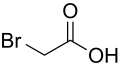 2-bromoacetic acid 200
 -
Bromoacetic acid 3D balls


Medical Disclaimer: WikiMD is for informational purposes only and is not a substitute for professional medical advice. Content may be inaccurate or outdated and should not be used for diagnosis or treatment. Always consult your healthcare provider for medical decisions. Verify information with trusted sources such as CDC.gov and NIH.gov. By using this site, you agree that WikiMD is not liable for any outcomes related to its content. See full disclaimer.
Credits:Most images are courtesy of Wikimedia commons, and templates, categories Wikipedia, licensed under CC BY SA or similar.
Translate page: - East Asian
中文,
日本,
한국어,
South Asian
हिन्दी,
தமிழ்,
తెలుగు,
Urdu,
ಕನ್ನಡ,
Southeast Asian
Indonesian,
Vietnamese,
Thai,
မြန်မာဘာသာ,
বাংলা
European
español,
Deutsch,
français,
Greek,
português do Brasil,
polski,
română,
русский,
Nederlands,
norsk,
svenska,
suomi,
Italian
Middle Eastern & African
عربى,
Turkish,
Persian,
Hebrew,
Afrikaans,
isiZulu,
Kiswahili,
Other
Bulgarian,
Hungarian,
Czech,
Swedish,
മലയാളം,
मराठी,
ਪੰਜਾਬੀ,
ગુજરાતી,
Portuguese,
Ukrainian


