Glucose oxidase
Glucose oxidase (GOx) is an enzyme that catalyzes the oxidation of glucose to hydrogen peroxide and D-glucono-δ-lactone. This enzyme is produced by certain species of fungi and insects and displays antibacterial properties.
Structure[edit]
Glucose oxidase is a dimeric protein with each monomer weighing approximately 80,000 daltons. Each monomer contains a tightly bound flavin adenine dinucleotide (FAD) molecule, which is essential for the enzyme's catalytic activity.
Function[edit]
The primary function of glucose oxidase is to break down glucose, producing hydrogen peroxide and D-glucono-δ-lactone in the process. The hydrogen peroxide produced can be used by other enzymes, such as peroxidase, to carry out a variety of reactions.
Applications[edit]
Glucose oxidase has a wide range of applications in different fields. In the food industry, it is used to remove glucose from egg whites to prevent browning. In medicine, it is used in glucose monitoring devices for people with diabetes. In biotechnology, it is used in the production of biofuel cells.
See also[edit]
- Enzyme
- Glucose
- Hydrogen peroxide
- D-glucono-δ-lactone
- Fungi
- Insects
- Dimeric protein
- Flavin adenine dinucleotide
- Peroxidase
- Food industry
- Medicine
- Diabetes
- Biotechnology
- Biofuel cells
| Enzymes | ||||||||||
|---|---|---|---|---|---|---|---|---|---|---|
|
.svg) | This biochemistry article is a stub. You can help WikiMD by expanding the page. |

-
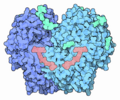 Structure of Glucose Oxidase
 -
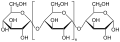 Structure of Poly-(1-4)-alpha-D-Glucose
 -
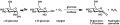 Reaction catalyzed by Glucose Oxidase
 -
 Glucose Oxidase enzyme from Aspergillus niger

-alpha-D-Glucose.svg)


Medical Disclaimer: WikiMD is for informational purposes only and is not a substitute for professional medical advice. Content may be inaccurate or outdated and should not be used for diagnosis or treatment. Always consult your healthcare provider for medical decisions. Verify information with trusted sources such as CDC.gov and NIH.gov. By using this site, you agree that WikiMD is not liable for any outcomes related to its content. See full disclaimer.
Credits:Most images are courtesy of Wikimedia commons, and templates, categories Wikipedia, licensed under CC BY SA or similar.
Translate page: - East Asian
中文,
日本,
한국어,
South Asian
हिन्दी,
தமிழ்,
తెలుగు,
Urdu,
ಕನ್ನಡ,
Southeast Asian
Indonesian,
Vietnamese,
Thai,
မြန်မာဘာသာ,
বাংলা
European
español,
Deutsch,
français,
Greek,
português do Brasil,
polski,
română,
русский,
Nederlands,
norsk,
svenska,
suomi,
Italian
Middle Eastern & African
عربى,
Turkish,
Persian,
Hebrew,
Afrikaans,
isiZulu,
Kiswahili,
Other
Bulgarian,
Hungarian,
Czech,
Swedish,
മലയാളം,
मराठी,
ਪੰਜਾਬੀ,
ગુજરાતી,
Portuguese,
Ukrainian

