N-Formylmethionine
N-Formylmethionine (fMet) is a derivative of the amino acid methionine in which a formyl group has been added to the amino group. It is specifically used by bacteria, mitochondria, and plastids for the initiation of protein synthesis. The presence of N-formylmethionine is one of the factors that differentiate bacterial proteins from those of eukaryotes and archaea, which start with methionine.
Structure and Properties[edit]
N-Formylmethionine is a peptide that contains a formyl group attached to the amino group of methionine. The formyl group is derived from formic acid, with the formula HCOOH. The presence of this group gives N-formylmethionine unique properties, such as a higher hydrophobicity compared to methionine.
Role in Protein Synthesis[edit]
In bacteria, mitochondria, and plastids, protein synthesis begins with the aminoacyl-tRNA carrying N-formylmethionine (fMet-tRNA^fMet) recognizing the start codon (usually AUG) on the mRNA. This is facilitated by the initiation factor IF2 (in bacteria) or IF2/IF3 (in mitochondria and plastids). The fMet-tRNA^fMet then forms a complex with the ribosome, allowing the addition of the next amino acid and the formation of the first peptide bond.
Clinical Significance[edit]
The presence of N-formylmethionine in bacterial proteins makes it a target for the immune system. Some antibiotics, such as daptomycin, work by binding to fMet-tRNA^fMet and preventing the initiation of protein synthesis. Additionally, the detection of N-formylmethionine can be used as a diagnostic tool for bacterial infections.
See Also[edit]
 | This medical article is a stub. You can help WikiMD by expanding the page. |
N-Formylmethionine gallery[edit]
-
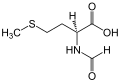 (S)-N-Formylmethionine V.1
-N-Formylmethionine_V.1.svg)

Medical Disclaimer: WikiMD is for informational purposes only and is not a substitute for professional medical advice. Content may be inaccurate or outdated and should not be used for diagnosis or treatment. Always consult your healthcare provider for medical decisions. Verify information with trusted sources such as CDC.gov and NIH.gov. By using this site, you agree that WikiMD is not liable for any outcomes related to its content. See full disclaimer.
Credits:Most images are courtesy of Wikimedia commons, and templates, categories Wikipedia, licensed under CC BY SA or similar.
Translate page: - East Asian
中文,
日本,
한국어,
South Asian
हिन्दी,
தமிழ்,
తెలుగు,
Urdu,
ಕನ್ನಡ,
Southeast Asian
Indonesian,
Vietnamese,
Thai,
မြန်မာဘာသာ,
বাংলা
European
español,
Deutsch,
français,
Greek,
português do Brasil,
polski,
română,
русский,
Nederlands,
norsk,
svenska,
suomi,
Italian
Middle Eastern & African
عربى,
Turkish,
Persian,
Hebrew,
Afrikaans,
isiZulu,
Kiswahili,
Other
Bulgarian,
Hungarian,
Czech,
Swedish,
മലയാളം,
मराठी,
ਪੰਜਾਬੀ,
ગુજરાતી,
Portuguese,
Ukrainian

