Pharmacodynamics of progesterone
Progesterone is a naturally occurring steroid hormone that plays a crucial role in several functions of the human body. The pharmacodynamics of progesterone involve its interaction with specific receptor proteins within cells, leading to a cascade of biological effects.
Mechanism of Action[edit]
Progesterone exerts its effects primarily through interaction with the progesterone receptor (PR), a member of the nuclear receptor superfamily of intracellular receptors. Upon binding to progesterone, the PR undergoes a conformational change that allows it to translocate to the cell nucleus, where it acts as a transcription factor to modulate gene expression.
Effects on the Body[edit]
Progesterone has a wide range of effects on the body, many of which are related to its role in the menstrual cycle, pregnancy, and embryogenesis. It prepares the endometrium for implantation of a fertilized egg and maintains pregnancy by suppressing uterine contractions. In the central nervous system, progesterone has been shown to have neuroprotective effects.
Pharmacokinetics[edit]
The pharmacokinetics of progesterone, including its absorption, distribution, metabolism, and excretion, also play a role in its pharmacodynamics. Progesterone is well-absorbed orally and is extensively metabolized in the liver by cytochrome P450 enzymes. It is primarily excreted in the urine as glucuronide and sulfate conjugates.
Clinical Use[edit]
Progesterone is used clinically in a variety of settings, including hormone replacement therapy (HRT), contraception, and the treatment of menstrual disorders. It is also used in fertility treatments to support the luteal phase of the menstrual cycle and in early pregnancy.
Side Effects[edit]
Like all medications, progesterone can have side effects. These can include mood changes, dizziness, headache, bloating, and changes in menstrual patterns. More serious side effects can include blood clots, allergic reactions, and depression.
See Also[edit]
- Pharmacokinetics of progesterone
- Pharmacology of steroids
- Hormone replacement therapy
- Contraception
- Menstrual disorders

 | This endocrinology article is a stub. You can help WikiMD by expanding the page. |
This gynecology related article is a stub. You can help WikiMD by expanding it.
 | This neuroscience article is a stub. You can help WikiMD by expanding the page. |
-
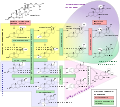 Steroidogenesis


Medical Disclaimer: WikiMD is for informational purposes only and is not a substitute for professional medical advice. Content may be inaccurate or outdated and should not be used for diagnosis or treatment. Always consult your healthcare provider for medical decisions. Verify information with trusted sources such as CDC.gov and NIH.gov. By using this site, you agree that WikiMD is not liable for any outcomes related to its content. See full disclaimer.
Credits:Most images are courtesy of Wikimedia commons, and templates, categories Wikipedia, licensed under CC BY SA or similar.
Translate page: - East Asian
中文,
日本,
한국어,
South Asian
हिन्दी,
தமிழ்,
తెలుగు,
Urdu,
ಕನ್ನಡ,
Southeast Asian
Indonesian,
Vietnamese,
Thai,
မြန်မာဘာသာ,
বাংলা
European
español,
Deutsch,
français,
Greek,
português do Brasil,
polski,
română,
русский,
Nederlands,
norsk,
svenska,
suomi,
Italian
Middle Eastern & African
عربى,
Turkish,
Persian,
Hebrew,
Afrikaans,
isiZulu,
Kiswahili,
Other
Bulgarian,
Hungarian,
Czech,
Swedish,
മലയാളം,
मराठी,
ਪੰਜਾਬੀ,
ગુજરાતી,
Portuguese,
Ukrainian

